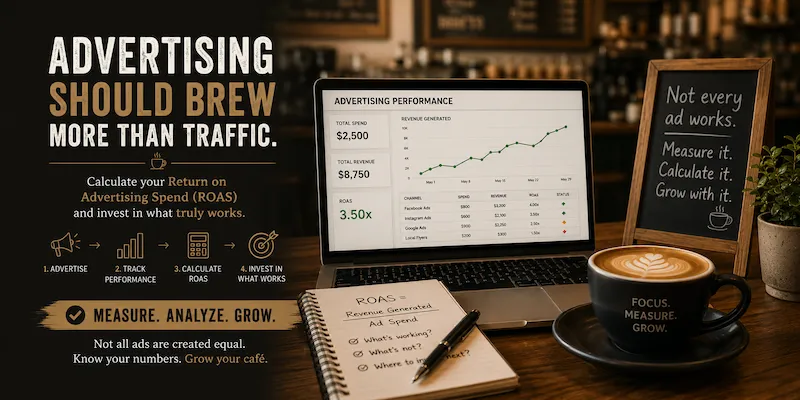
ROAS stands for return on advertising spend. Most independent retailers never calculate it. They just hope.
It sits alongside the other numbers that tell you whether your business is actually working. If you haven't read our piece on financial KPIs for independent cafés and retailers, that's worth doing first. ROAS is the marketing half of the same discipline.
Most retailers worry about the wrong thing when it comes to marketing. They worry about the method. Where to advertise, which platform, which sign to put up. What they should worry about is whether any of it comes back to them in cash. Plenty of shop owners open their doors on day one assuming customers will simply arrive. They don't. Someone has to go and get them, and then someone has to work out whether that effort was worth it.
What I did at Shakes 2GO
Before I opened, I had a clear picture of who my customers were going to be. I built four customer profiles and ranked them in order of importance.
Teenagers aged 13 to 19 were my priority. Second came 19 to 30 year olds, many still in full time education at college or university. Third were children under 13, where the actual buying decision sits with a parent. Fourth were adults over 30.
My message was 100+ flavours of milkshake. Not the greatest hook looking back, but not the worst either.
I made leaflets with an offer on them, free topping with every leaflet, showed a handful of flavours, added a map, opening times, and the address. No website. I did put together a Facebook page.
Then, before the shop opened and before the schools went back, I went out and hit a different school each day, then the college, then the university.
My location wasn't great, so some days I stood at the bottom of the road handing out leaflets to pull people up the street. I also had an A-board leaning against a kebab shop on the corner during the hours they were shut.
The leaflets I could measure. I kept a box of the returned ones and tallied them against the number I'd sent out, so I knew they were bringing people in. The A-board I couldn't measure at all. It might have done nothing. It might have done plenty. I had no way of knowing, and that's exactly the trap this whole post is about.
Looking back, I should have coded each batch of leaflets by the location I handed them out at. That way I'd have known exactly which school, which street corner, which effort actually paid off, rather than just knowing that something out there was working.
The point of all this
You need to know whether what you're doing is making you money.
For leaflets, it's simple. Add up the cost of printing them and the cost of the time spent handing them out, even if that time is your own. That's the spend side of the equation. Without it you can't calculate a return on anything, because you don't actually know what you spent.
💡 The Simple Rule
If you can't put a number on what a marketing activity cost you, in cash and in hours, you can't put a number on whether it worked. Vague effort gets vague results and no way to tell them apart from luck.
Social media isn't free
Ask yourself whether you add up all the hours you spend on social media. Do you know what you get back for that time? How many new customers actually walked in because of a post?
People assume social media is free because there's no invoice for it. There is a cost. It's your time, and time is the one thing you can't get more of. Likes and follows feel good, but the real question is how many of those people are spending money in your shop.
If you run an offer on social media, say free cake with every coffee, you need a way to track it. Give customers a word or phrase to say at the till, and have your staff tally it. If you're handing out leaflets, keep the returned ones in a box and count them by day. Better still, staple a copy of the receipt to the leaflet and ask whether it was their first visit.
Cross promotion
Get another local business to hand out your leaflets, and do the same for them. That's cross promotion, and it works when both sides are chasing the same kind of customer without competing for their spend.
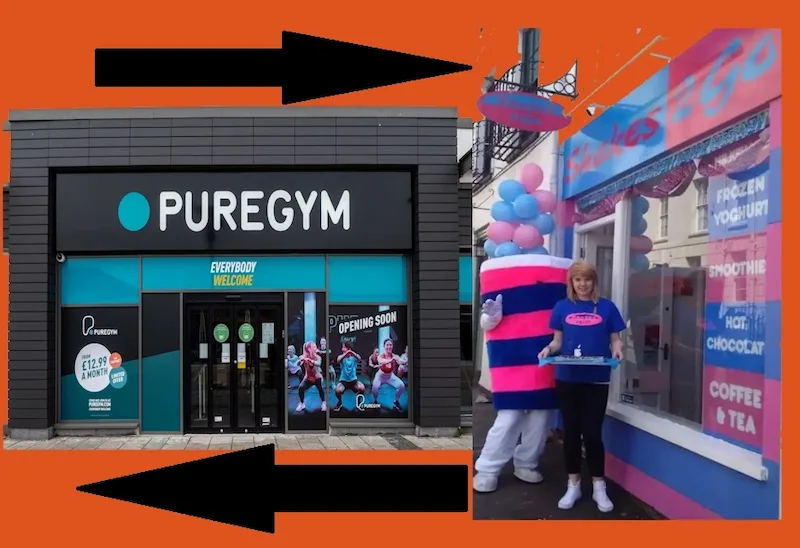
At Shakes 2GO we did this with a tattoo parlour and with a couple of nearby gyms, where we pushed our protein shakes made with real fruit and fat free frozen yogurt. Different products, same kind of customer walking through both doors.
Whatever method you choose, build in a way to measure whether it worked. If you can't measure it, you can't tell the difference between a good idea and money down the drain.
💡 Before You Start Any New Marketing Push
Decide how you'll measure it before you spend a penny or an hour on it. A tally box, a code word at the till, a receipt stapled to a leaflet. Pick something. Anything is better than finding out six months later that you have no idea whether it worked.
Where this connects to your customer data
Tracking leaflets and social media offers gets you as far as knowing whether a campaign brought people in. What it doesn't do on its own is turn those people into regulars. That's a separate job, and it's one most independents leave to chance in exactly the same way they leave their marketing spend to chance.
A digital loyalty card does two things at once. It gives new customers a reason to come back, and it gives you their name and phone number the moment they join, so you're not just hoping the leaflet worked. You've got a contact you can actually market to next time.
That's exactly what PerQ is built for.
Try PerQ free for 30 days
Running an independent café or retail business? PerQ is a digital stamp card loyalty programme built for independent operators. No app download required, no technical setup headaches, and no long-term contracts.