If you've ever sent a newsletter and watched a fifth of your list open it, you already know the problem. Email still has a place in your marketing. Text messaging is what actually gets read.
Email Still Earns Its Spot
Newsletters are a weekly appointment. You show up, you share something useful, a recipe idea, a new product, a story about the shop, and over time you build trust. That slow drip works for email because nobody expects a newsletter to be read the moment it lands. It sits in the inbox until someone has five minutes, and that's fine for content that isn't time-critical.
But a newsletter is not a flash sale. It's not "we've got 12 seats left for Friday's cupping night" or "quiet this afternoon, pop in before 3pm for a free pastry with any coffee." For anything that needs eyes on it today, email is the wrong tool, and the numbers back that up.
The Gap Between Email and Text Is Not Close
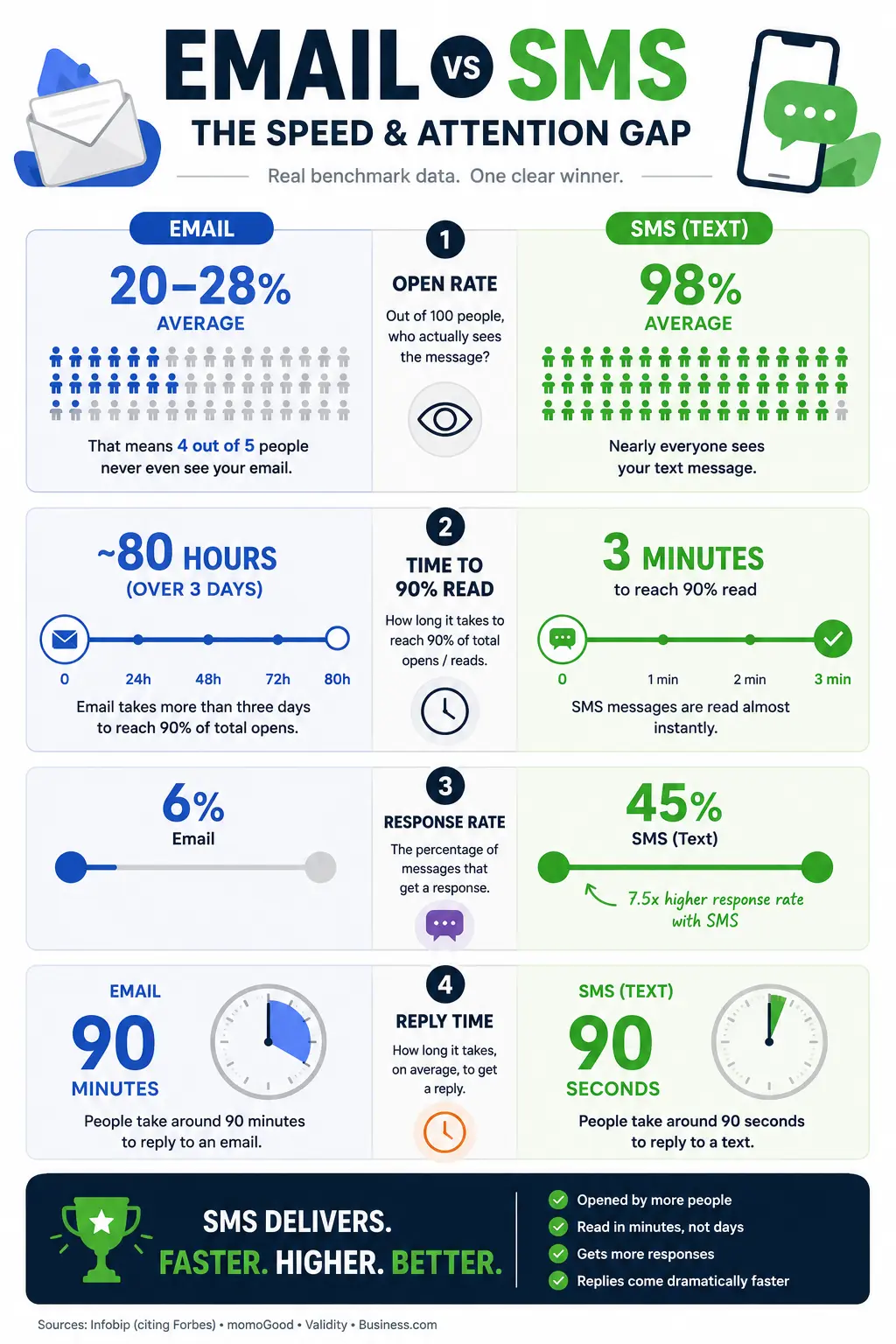
Email open rates average between 20% and 28% across industries, according to benchmark data compiled by Infobip citing Forbes. Text messages average a 98% open rate over the same measurement. That's not a modest edge. Four out of five people on your email list never even see the message you sent them.
Speed matters just as much as whether the message gets opened at all. Research from momoGood shows that only 10% of emails are opened within the first hour, and it takes roughly 80 hours, over three days, to reach 90% of total opens. Text messages don't work on that timeline. Validity's deliverability research puts 90% of SMS messages as read within three minutes of arriving.
Response behaviour tells the same story. Business.com's benchmarking finds SMS response rates around 45%, compared with roughly 6% for email, a gap of more than seven times. And when people do respond, they respond fast: the average reply to an email takes about 90 minutes, while the average reply to a text takes about 90 seconds.
Why This Matters More for a Café Than Most Businesses
A loyalty database is only worth something if you can actually reach the people in it when it counts. The real value of your customer list isn't the quiet Tuesday afternoon regulars who'll come in anyway. It's the ability to fill a slow period, sell out a ticketed tasting evening, or clear stock on something perishable before it goes to waste, and all of that depends on the message being seen within hours, not sometime next week when someone finally clears their inbox.
💡 The Whole Reason PerQ Works This Way
PerQ is built around collecting a mobile number at sign-up rather than an email address. A wallet pass update lands the way a text does, not the way an email does. When you push an update to say tonight's event has two spaces left, you need it read in the next hour, not the next few days.
None of this makes email useless. If you want to run a weekly newsletter to stay front of mind and share things worth reading, that's still a job email does well, and it's worth doing alongside your PerQ database, not instead of it. The two channels aren't competing for the same job. One builds the relationship over time. The other gets people through the door today.
Frequently Asked Questions
Why does PerQ collect a mobile number instead of an email address?
Text messages average a 98% open rate compared with 20-28% for email, and 90% of texts are read within three minutes rather than sitting in an inbox for days. A loyalty database is only worth something if you can actually reach people in it when it counts, so PerQ is built around the channel that gets seen.
Does this mean email marketing doesn't work for cafés?
No. Email still does a good job for a weekly newsletter that builds trust over time, since nobody expects a newsletter to be read the moment it lands. It's the wrong tool for anything time-sensitive, like a flash sale or a same-day event with spaces left.
How much faster do people read a text than an email?
Research from momoGood shows only 10% of emails are opened within the first hour, and it takes roughly 80 hours, over three days, to reach 90% of total opens. Validity's deliverability research puts 90% of text messages as read within three minutes of arriving.
Is this data specific to cafés, or general marketing benchmarks?
These are general SMS and email marketing benchmarks compiled across industries by sources including Infobip (citing Forbes), Validity, Business.com, momoGood and CartBoss, applied here to the specific problem of filling a quiet afternoon or selling out an evening event.